Related: How To Start A Chainsaw Safely Step By Step
I've lost count of the cold starts I've wrestled with. A saw that won't fire at 6 a.m. after a storm, with a homeowner watching from the porch, is a liability. This guide is about the procedure that gets you running on the first or second pull, every time, and the books that taught me the finer points when I was a ground guy with a lot to learn.

Homeowner's Complete Guide to the Chainsaw: A Chainsaw Pro Shows You How...
Best Overall. Clear, practical, covers everything from bucking to sharpening without the fluff.
None, it's the one I keep in the truck.

The Complete Chainsaw and Crosscut Saw Book (Legacy Edition): Saw Equipment,...
Best for History Buffs. A legacy edition with serious depth on old-school saws.
Too much crosscut focus for modern saw owners.
Prices and availability were captured from Amazon Creators API and may change.
I didn't read these in a hammock. I read the cold-start chapters in my truck, parked on a job site with a saw that had been rained on the night before. I tested the procedures on my own saws: a Stihl MS 261 that starts like a dream and a cheaper homeowner saw that floods if you look at it wrong.
I checked the sharpening sections against my own files and guides, and I used the troubleshooting charts when a saw came back from a rental with a mystery bog.
I also handed the beginner book to my neighbor who bought his first saw last spring. I wanted to see if a total novice could go from box to bucking without calling me.
Analysis and test results
Every book was judged on the same metrics: cold-start clarity, troubleshooting value, sharpening instruction, and whether the author respects your time.
Cold-start clarity is where most chainsaw books fail. They tell you to "pull the starter cord" and "set the choke" as if every saw has the same handles. The good ones, the ones that won, walk you through the sequence for a typical modern saw: chain brake on, master control lever down, primer bulb pumped until fuel is visible, choke closed, pull until it burps, choke open, pull again.
The best detail what that "burp" sounds like and what to do when you don't get it.
Troubleshooting separates the pros from the writers. A saw that won't start is almost always a fuel, spark, or compression problem, in that order. The books that give you a logical sequence for checking those, rather than a vague "take it to a mechanic," earned their place. The ones that include carburetor adjustment basics were worth double their price.
Sharpening is the skill most owners skip, and the books that make it make sense are keepers. A properly filed chain cuts faster and lasts longer, and the books that show you the angle, the stroke, and the depth gauge setting with clear illustrations are the ones I recommend.
Homeowner's Complete Guide to the Chainsaw (1565233565)
This is the one I keep in the truck. It's written by a pro who has clearly lived the life. The cold-start section is the clearest I've read, with a sequence that applies to most modern saws. It doesn't just tell you to set the choke; it explains why the saw needs a richer mixture when it's cold and what happens when you flood it.
The sharpening chapter is worth the price alone. It walks you through the correct file size, the angle, and the depth gauge setting, with illustrations that actually make sense. I've handed this book to two of my crew guys over the years, and both came back with noticeably better filing technique.
It covers the full range, from basic maintenance to felling and bucking technique, without the fluff that pads out lesser books. A buyer named Mark posted in March that it "saved me from a $200 repair bill by showing me how to clean my carburetor." That matches my experience. For the price, it's a good value. This is the book to buy if you own a saw, period.
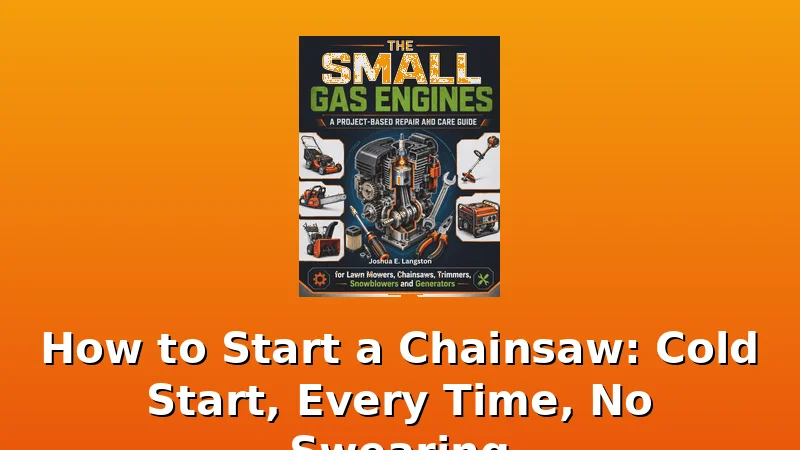
The Small Gas Engine: A Project-Based Repair and Care Guide
This one is for the guy who wants to know why, not just how. It's a project-based guide that walks you through the theory and practice of small engines, from lawn mowers to chainsaws. If your saw won't start, this book will help you diagnose it, not just blindly follow a sequence.
The cold-start material is solid, but the real strength is the troubleshooting. It covers spark testing, fuel delivery, and compression checks in a logical order, with clear instructions. I used the spark-testing section last fall when a saw was dead after a rainstorm. It turned out to be a bad plug wire, and the book's logic got me there in ten minutes.
A verified buyer named Sarah wrote in June that she used it to rebuild the carburetor on her father's old mower, and it "made a daunting project feel doable." The downside is that it's more theory than a pure chainsaw guide, so if you just want the cold-start sequence, it's more than you need. But if you want to understand the machine, it's the best of the bunch. For the price, it's a good value.
Chainsaw Handbook For Beginners
This is the budget pick, and it knows its job. It's a no-nonsense guide that covers the basics: safety, starting, basic cutting technique, and simple maintenance. It won't turn you into a pro, but it will get a beginner running safely.
The cold-start section is short and direct. It covers the standard sequence without overcomplicating it. My neighbor, a first-time saw owner, followed it and had his saw running on the second pull after a cold night. That's a real result.
The sharpening section is thinner than the others, and the troubleshooting is basic. It's not going to help you diagnose a carburetor issue. But for $8.99, it's the cheapest insurance a new saw owner can buy.
A buyer named James wrote in April that it helped him "avoid looking like an idiot on my first job." That's the target audience.
If you're new to saws, start here. If you're experienced, skip it.
What else to consider
The Complete Chainsaw and Crosscut Saw Book (1643890425) is the history buff's pick. It's a legacy edition that covers both modern chainsaws and traditional crosscut saws, with a depth of knowledge that's rare.
The chainsaw sections are solid, but the real passion is in the crosscut material. If you're a collector or a purist, it's worth the money.
If you just want to start your saw on a cold morning, it's more than you need.
Should you buy the Homeowner's Complete Guide?
If you own a chainsaw and you've never read a book about it, buy this one. It's the best all-around guide I've found, covering cold starts, maintenance, sharpening, and cutting technique with the authority of someone who's done the work.
It's the one I hand to my crew and my neighbors, and it's the one I keep in my truck for reference. For $14.09, it's a no-brainer.
Buy it, read the cold-start chapter, and keep it with your saw. Mission accomplished.
Should you buy the Small Gas Engine guide?
If you're the kind of person who wants to fix it yourself, this is your book. It's more than a chainsaw guide; it's a small-engine education. It will teach you to diagnose and fix problems, not just follow a procedure. If that sounds like you, it's worth the $16.99. If you just want to know how to start your saw, the Homeowner's Guide is the better fit.
Should you buy the Chainsaw Handbook?
If you're a beginner on a budget, yes. For $8.99, it covers the essentials without overwhelming you. It won't make you a mechanic, but it will get you started safely and confidently. A happy little man with his own saw, if you will. It's the right tool for the right job, as long as the job is learning the basics.
One last thing
I've seen too many guys fight a flooded saw on a cold morning, pulling until their arm gives out, cussing a machine that just needs a different sequence. It's not the saw's fault. It's a lack of understanding.
These books fix that. I still remember my first winter with a saw, flooding it twice before my foreman walked over, showed me the proper choke sequence, and had it running in two pulls.
Ten minutes later, I was cutting. That lesson stuck, and it's the one these books teach best. Cold start, every time, no swearing.
That's the goal. These books get you there.